


Counter Christianity and Koinonia: Rethinking Church Social Action
Updated: May 26
These reflections come after spending a day with Hope into Action at their annual conference, Rooted: Homelessness Ends in Community. In particular, they were stirred afresh while listening to the seminar Rethinking Poverty and Our Response with Jon Kuhrt and Rachel Arnold, both shaped by the wider imagination of Together for the Common Good and the work of Jenny Sinclair. For those familiar with these voices, there will be little here that is entirely new. I am simply trying to put words around questions some of us working around poverty, homelessness, church, and community have been carrying for a number of years.
What follows paints with broad strokes at times. Reality is always more complex than this, and many churches embody deep forms of shared life and hospitality. But I still think the tension being described here is real and worth naming.

There is a kind of Christianity that excels at projects.
The foodbank is organised, the referrals are done, the safeguarding structures are in place, and the church becomes increasingly competent at delivering social action — sometimes directly, sometimes by hosting charities, offering buildings and resources, and functioning as a volunteer base for wider community initiatives.
Much of this work is deeply good and necessary. In the middle of austerity, rising poverty, broken housing systems, addiction, loneliness, and overwhelmed public services, churches have often stepped into the gap with real compassion and sacrifice.
But I sometimes wonder whether parts of the church have quietly drifted into a very different imagination of what Christian community is meant to be.
I sometimes describe this shift as counter Christianity.
And I mean counter in two senses.
A counter is the place where things are handed over — food parcels, vouchers, forms, advice, a pair of trainers. A transaction takes place. Need is met, help is given, and then the interaction ends.
But I also mean counter as metaphor. The counter is the thing standing between the Christian and the person receiving help. It creates distance and establishes roles. One person becomes the helper. The other becomes the helped. One remains named and capable; the other slowly risks becoming reduced to need.
Client.
Service user.
The vulnerable.
The homeless.
The addict.
Now those terms are not always malicious. Institutions need categories and systems. But language shapes imagination. Unless we are careful, the church can slowly begin to mirror the logic of institutions more than the logic of the kingdom of God.
The poor are welcomed, but
often mainly as recipients.
Present, but
still somehow peripheral.
In the room, but
rarely shaping the room.
And often this happens unconsciously. A church may genuinely want diversity while still expecting everybody to quietly adapt to middle-class norms around behaviour, communication, emotional expression, and respectability.
These questions have perhaps become even more urgent in recent years because of the enormous rise in church-based social action during and after the Covid pandemic. Across the country, churches stepped into crisis with extraordinary generosity — food provision, debt support, warm spaces, wellbeing projects, community hubs, emergency response.
Much of that work was beautiful and necessary.
But as churches increasingly organise around social action, deeper questions around relationship, power, belonging, and dependency become more important, not less.
Who controls the space?
Who decides what help looks like?
Who gets listened to?
Who remains comfortable?
Because dependency can quietly form inside church projects in ways nobody intended. Not simply material dependency, though that can happen too, but relational dependency.
The church can unconsciously create a permanent divide between “those who help” and “those who are helped.”
People may receive support for years without ever fully becoming participants in the life of the community — contributors, friends, decision-makers, or family within the church itself.
And yet the gospel keeps disrupting those categories.
In the kingdom of God, the poor are not merely objects of compassion or recipients of ministry.
They are bearers of the image of God. Friends. And for those who name the name of Christ, brothers and sisters. People with gifts, wisdom, humour, resilience, and prophetic voices the wider church desperately needs.
I do not write this as somebody hostile towards larger churches, structures, or organised ministry. Alongside leading Lighthouse — a church and Christian community for those battered and bruised by the storms of life, gathering on Sundays in a café-style space inside a homeless shelter in Leeds and throughout the week across six locations — I also served for twelve years within a city-centre resource church context.
In fact, Lighthouse itself was initially planted by that church and remained embedded within it for several years before later becoming an independent charity and church community in its own right. I remain deeply grateful for much of that experience and for many people within those churches.

But working closely among people on the margins has made me think more deeply about what Christian community actually is, and what happens when social action becomes separated from shared life.
At Lighthouse we try intentionally not to call people clients or service users. Not because language magically fixes everything, but because words reveal what kind of community we think we are building. A client receives a service. A brother or sister belongs.
None of this means projects are bad.
Projects matter.
Structures matter.
Safeguarding matters.
Foodbanks matter.
Support services matter.
And sometimes the counter is necessary.
And many churches embody deep and beautiful forms of koinonia. Across the country there are churches quietly sharing meals, carrying burdens, fostering, housing people, praying together, grieving together, and building genuine communities of belonging across difference.
The point is not that projects or structures are wrong, but that social action on its own is not yet the fullness of the church’s calling.
The church is not simply called to run compassionate initiatives for people, but to become a people among whom strangers slowly become family, a community of covenant and kinship.
Because people are not projects.
They are image bearers.
Friends.
Brothers and sisters.
The danger is when the project keeps running, but people stop really knowing one another.
And perhaps this is part of what the New Testament means by koinonia.
At the end of Lighthouse Sundays, somewhere between washing the pots and cleaning the toilets, we often say the grace together after a quick debrief and prayer. We say it standing in a circle with our eyes open — what we jokingly call “holy eyeballing.”
“May the grace of the Lord Jesus Christ, and the love of God, and the fellowship of the Holy Spirit be with us all.”
That word “fellowship” is koinonia.
Koinonia is more than friendliness or hospitality. It is participation in the life of God through the Holy Spirit — a shared communion rooted in Christ himself. The church is not simply a collection of individuals who happen to worship in the same room. It is a people being drawn into the life, love, and self-giving communion of the Triune God.
Not just friendliness after church.
Not networking.
Not simply turning up to meetings.
Shared participation in the life of God through the Holy Spirit.
But also the Holy Spirit knitting people together into a new kind of community. Lives woven together through mercy, prayer, burden-bearing, forgiveness, and love.
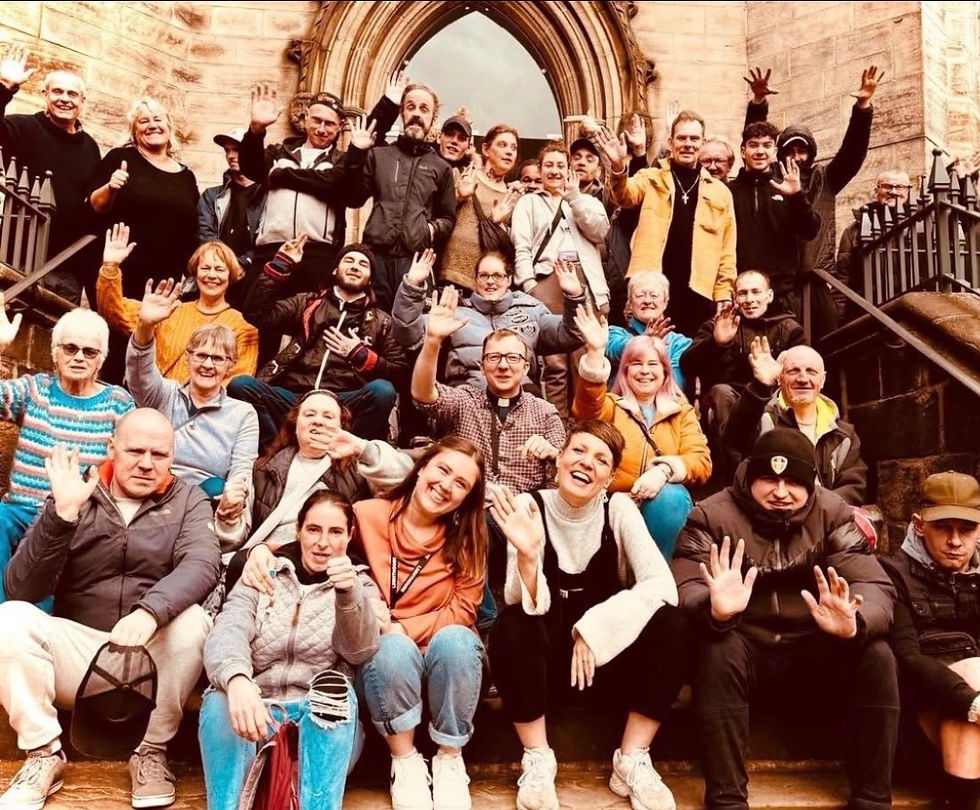
Often when Lighthouse gathers for worship, the service leader says these words:
“In a world which seems to love to drop bombs and build walls, Jesus is doing something different. He is building a family where people like me and people like you, from different experiences and different backgrounds, can look at each other and with honesty and integrity and say: you are my brother, and you are my sister.
The peace of the Lord be with you.”
And everybody responds:
“And also with you.”
Then hugs, fist bumps, handshakes, and friendly nods move around this motley crew.
At times it feels almost sacramental — a thin space where grace hangs quietly in the air.
A strange and beautiful thing: brothers and sisters dwelling together in unity.
To me, that is part of what the kingdom of God looks like.

I have a photograph from a few years ago when Lighthouse was more embedded within the larger resource church from which it first emerged. A group of lads are standing at the top of the church steps dressed as shepherds before the main nativity service of the year.
Some had experienced homelessness.
Some were ex-offenders.
Some had struggled deeply with mental health.
And there they were, laughing together, welcoming families as they climbed the church steps for the Christmas service.
I love that photograph because it captures something true about the kingdom of God.
In the world of the first century, shepherds sat low in the social imagination. They were associated with roughness, unpredictability, and the edges of respectable society. Yet in Luke’s Gospel it is shepherds — not emperors, not religious elites, not the powerful — who first receive the good news of Christ’s birth.
In the story of Jesus, the outcasts are not pushed to the edge of the story. They are invited close.
And sometimes the people society expects to remain recipients of welcome become the very people through whom welcome is given.
Some of the most important ministry at Lighthouse looks deeply ordinary. Sometimes it involves the leaders, paid staff or volunteers. Sometimes it doesn’t.
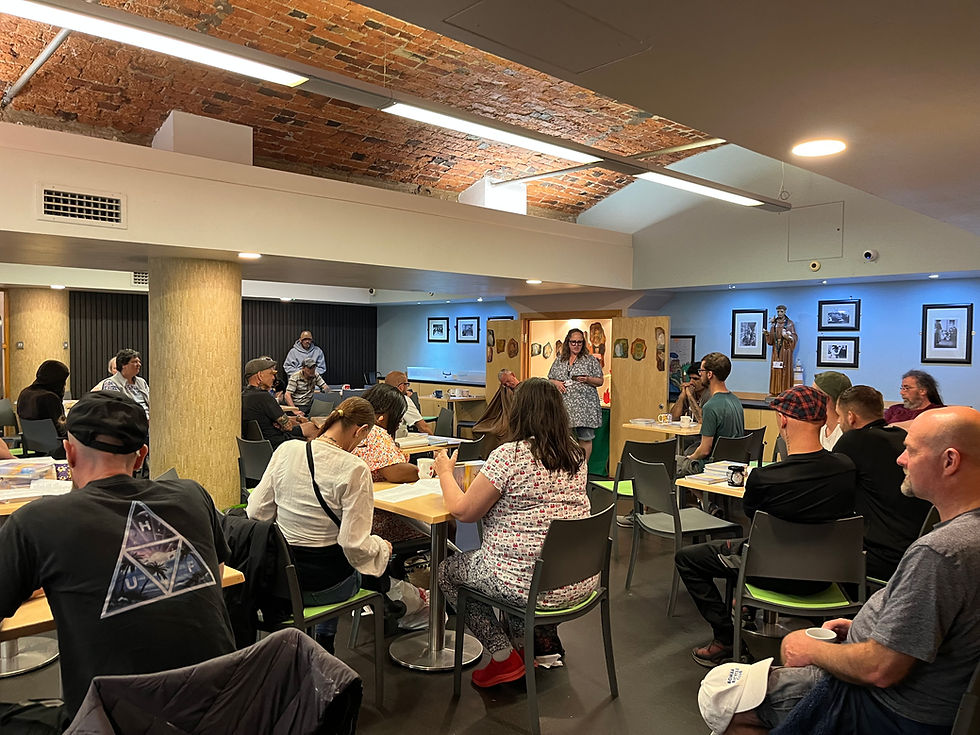
People playing dominoes.
Banter.
Singing “Happy Birthday” and eating cake.
Making brews.
Washing pots.
Singing Together, sometimes dancing.
Arts and crafts.
Telling jokes and stories.
Smoking outside together.
A trip to the art gallery or the local park.
A game of rounders or charades.
Praying quietly with somebody carrying grief in their bones.
Remembering somebody’s court date.
Noticing when somebody disappears.
Laughing together.
Mourning together.
Small things.
But holy things.
I remember one afternoon when a man who had first come to Lighthouse needing support ended up sitting quietly praying with somebody else who was falling apart. Nobody had organised it. No programme had produced it. It simply emerged from life together.

Last year Sr Margaret, my first theology tutor from nearly thirty years ago, visited Lighthouse. She was welcomed by those on the margins, and one member of our community — who had previously been living in a car park — prayed for her. He also prayed for the Catholic priest accompanying her, asking that he might know healing from his chronic pain.
There was something deeply beautiful about it all.
The one once dismissed as broken becoming the one who ministers.
The vulnerable becoming the vessel of grace.
Blessed to be a blessing.
And I have seen this kind of thing again and again among people the wider world often only describes through deficits.
Sometimes people on the margins carry a kind of honesty more comfortable churches can lose. There is less room for performance. Less ability to maintain the illusion of self-sufficiency.
And alongside immense pain, you often encounter extraordinary generosity.
I have seen people with almost nothing open their homes to somebody else in crisis. I have watched people share their last bit of baccy, their last few pounds, their last food. I have seen people sit in hospital for hours with somebody everybody else had forgotten.
Not romanticised. Not idealised.
But sometimes communities on the margins expose how individualistic and emotionally defended the wider culture — and sometimes the church — has become.
Humans are not islands, cut off from one another. We are relational creatures made in the image of a relational God. Father, Son, and Holy Spirit exist eternally in communion, love, and self-giving relationship. To be made in the image of God is therefore to be made for communion rather than isolation.Yet much of late modern culture trains us towards autonomy, self-protection, and radical individualism. Every person for themselves. Freedom increasingly imagined as independence rather than interdependence.
But the kingdom of God moves in another direction.
Jesus did not remain at a safe professional distance from suffering. Again and again in the Gospels, Jesus eats with people — tax collectors, sinners, the poor, outcasts, and those respectable religion preferred at a distance.
Meals become places where social boundaries begin to collapse.
Perhaps this is why meals matter so much in the ministry of Jesus. Around tables, status begins to loosen.
The Eucharist itself is not a private religious act but a shared meal of dependence and grace. We come empty-handed. We receive mercy together. The ground is level there.
The early church understood something many modern churches have forgotten. Acts describes believers as those devoted to “the fellowship (koinonia), to the breaking of bread and the prayers.” Resources were shared. Burdens were carried together. Economic life, worship, meals, and belonging became intertwined.
That is not simply charity.
It is common life.
The church was never meant to become merely an extension of the state or a servant filling gaps left by political failure. It is something stranger and more beautiful than that: a Christ-centred koinonia, a fellowship of differents.
This is why the words of Jesus remain so searching:
“By this everyone will know that you are my disciples, if you love one another.” (John 13:35)
Love is a relational word. It cannot be reduced to programmes or institutional efficiency. It requires presence. Patience. Staying around long enough for people to become known.
You cannot love people while permanently keeping them on the other side of the counter.
And perhaps that matters even more in the years ahead.
Loneliness, inequality, housing pressures, ecological crisis, and political instability are already straining the fabric of society. I do not know exactly what the future holds. But I do think the church will need deeper roots than programmes alone.
Which means the church cannot simply become a more efficient provider of religious services within a fragmenting culture.
We are being called to become communities of deep belonging.
As the Psalmist writes:
“God sets the lonely in families.” (Psalm 68:6)
Places where people know one another.
Carry one another.
Share resources.
Pray together.
Eat together.
Mourn together.
Pope Francis has often warned about the danger of what he calls a “throwaway culture,” where people become disposable once they are no longer useful, productive, or easy to accommodate. In contrast, he speaks about the need for a “culture of encounter.”
He writes:“A culture of encounter demands that we be ready not only to give, but also to receive.”
That is a profound challenge to forms of charity which only move in one direction.
The poor are not simply people to whom the church brings Christ.
They are also people through whom Christ comes to meet the church.
And there is a prophetic dimension to this.
Jon Kuhrt has warned that the church can become little more than a handmaiden to the state, plugging gaps left by austerity, welfare cuts, collapsing social care, housing failures, and economic violence. There is truth in that warning.
The church can end up endlessly managing social pain without ever asking why so many people are bleeding in the first place.
We feed people,
but rarely ask why people are hungry.
Or as Rachel Arnold observed, we collect donations from supermarkets for our foodbanks while often saying very little about the economic systems underneath them — systems where enormous profits flow upwards to shareholders even as jobs quietly disappear from local communities through self-checkouts and automation.
But relational Christianity pushes us beyond this. Because once the poor are no longer “them” but part of “us,” suffering can no longer remain abstract.
Once you know people, eat with people, love people, pray with people, visit them in hospital, and bury people, the pain stops being theoretical.The church is no longer advocating for outsiders from a safe moral distance.
We are speaking about our friends.
Our brothers.
Our sisters.
The biblical prophets were not detached commentators speaking about suffering from afar. They lamented from within the anguish of the people. The cry for justice in Scripture emerges from shared pain.
It is harder to speak in abstractions once suffering has a face and a voice and you know the person’s name.
The kingdom of God seems to move against isolation.
Towards communion.
Towards common life.
Towards tables rather than counters.
Of course the church must feed people. Of course we provide support. Love requires that.
But we are also called to become communities where suffering is shared deeply enough that we begin to cry out together.
Not their struggle,
but ours.
Maybe the kingdom of God does not always look impressive.
Sometimes
it looks like wounded people
refusing to leave one another alone.
Sometimes
it looks like somebody making tea
while another person
cries quietly at the table.
Sometimesit looks like prayer
offered through cigarette smoke
outside a church door.
Sometimes
it looks like bread broken
among people
who know they need mercy.
Sometimes
it looks like the person
who first arrived needing help
becoming the one
carrying somebody else’s pain.
And perhaps that is why the title of the conference stayed with me all day:
Rooted: Homelessness Ends in Community.
Not simply in services.
Not simply in projects.
Not simply in systems, important though those are.
But in people becoming family.
In a fragmented world, perhaps one of the most prophetic things the church can become is a people who refuse isolation, refuse disposability, and refuse to leave one another alone.
Not on the safe side of the counter,
but around tables where lives
are slowly being
knitted together in love.
Further Reading
Christian Calling and the Relational Imperative — Jenny Sinclair
Prophet or Provider? Being a Voice for Change Whilst Meeting the Needs of People at the Margins–John Kuhrt
Fratelli Tutti: On Fraternity and Social Friendship — Pope Francis
22nd May 2026
Rev’d Jon Swales
Rev’d Jon Swales MBE is an Anglican priest, prophetic theologian, and poet. He is lead tutor at Lighthouse School of Missional Theology and a course tutor for Mission, Theology and Ministry for the Margins. He is the author of three books: Let Me Be the Kind Who Weeps, East of Eden, and Lament and Hope.


I recognise our small rural communities in this piece but sometimes we have not enough resources - one of our churches has no loo, no disabled access so cannot get grants to build a loo for example. Heating is just not possible there in winter so no services except Christmas,
We pray, we work but our hopes and dreams are restricted to narrow possibilities at present.
Thank you for your understanding Jon of the preciousness of people.